One-line definitions that actually help
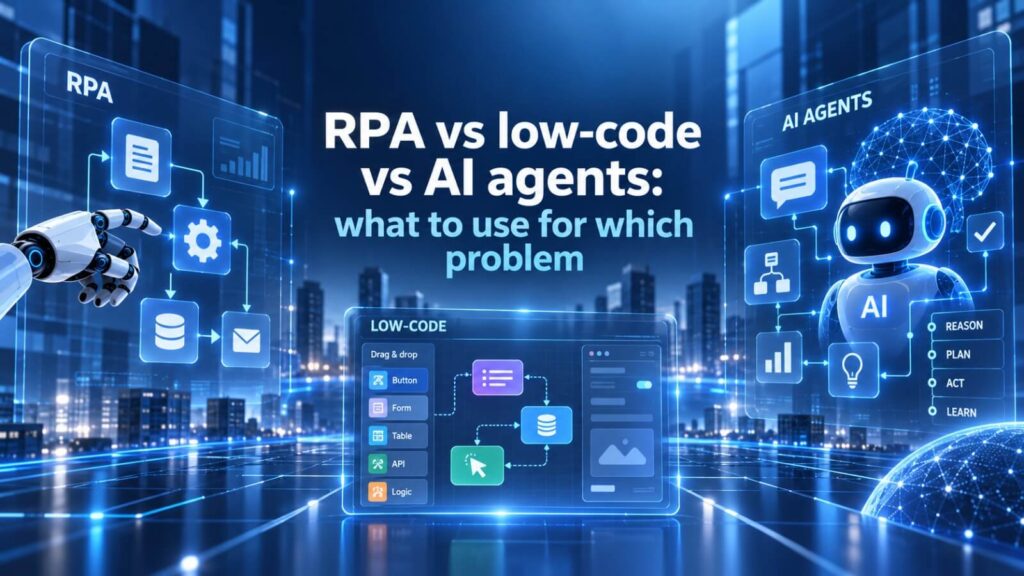
When every vendor promises “automation,” it’s easy to treat RPA, low-code and AI agents as three brands of the same thing. They aren’t. Each solves a fundamentally different problem, and the failure mode is always the same: forcing one tool to do a job it was never built for — an RPA bot asked to make judgement calls, a low-code app expected to read unstructured documents, an AI agent pointed at a task that needed a deterministic rule. Get the match right and delivery is fast and durable. Get it wrong and you’ll spend the year firefighting. RPA automates repetitive, rules-based steps across existing systems — the digital equivalent of a person clicking through screens the same way every time. Low-code is for building the thing itself — an app, a form, a workflow, a portal — quickly and visually. AI agents are for work that needs judgement and can’t be fully scripted — reasoning over messy inputs, deciding a next step, and orchestrating actions across tools toward a goal. Different jobs, different tools.The comparison at a glance
| RPA | Low-code / no-code | AI agents | |
|---|---|---|---|
| Best for | Repetitive, rules-based steps across systems | Building apps, forms & workflows fast | Judgement, unstructured inputs, multi-step goals |
| Input type | Structured, predictable | Structured (you design it) | Unstructured & ambiguous |
| Behaviour | Deterministic — same result every time | Deterministic logic you configure | Probabilistic — reasons & adapts |
| Change tolerance | Low — breaks when screens/systems change | Medium — you maintain the app | High — handles variation, but less predictable |
| Speed to deliver | Fast for a defined task | Very fast for an app | Fast to prototype, slower to harden |
| Main risk | Brittleness | Shadow IT / sprawl | Accuracy, oversight & cost |
| Human role | Exceptions only | Uses the app | Reviews & approves (human-in-the-loop) |
A five-question chooser
Run a process through these questions and the right tool usually falls out:Use RPA
Is it repetitive, rules-based and stable, moving structured data between systems? If the same inputs always produce the same steps and there’s no real judgement, RPA is the fastest, cheapest fit.Use low-code
Do you need to build an app, form, workflow or portal — a new experience for people to use? When the gap is a missing tool rather than a repetitive task, low-code delivers it in days, not quarters.Use AI agents
Does it require reading unstructured content, interpreting intent, or deciding a next step? If a rule can’t capture it and outcomes vary with context, an AI agent supplies the judgement — with a human reviewing where it matters.Combine
Does the end-to-end process span all three — understand, decide, execute, and give people a way to act on exceptions? Most valuable processes do. Compose them rather than choosing one.Worked examples
Invoice processing.
The invoice arrives as a PDF (unstructured) — an AI model reads and extracts the fields; RPA posts the validated data into the ERP (structured, rules-based); a low-code app routes the exceptions that need a human approval. Three tools, one clean flow.Employee onboarding.
A low-code app captures the request and orchestrates the workflow; RPA creates accounts and provisions access across systems; an AI assistant answers the new joiner’s questions and drafts the welcome pack.Customer support.
An AI agent summarises the case and drafts a response; RPA pulls order and account data from back-end systems; a low-code console gives agents one place to review and send. The recurring pattern: AI to understand and decide, RPA to execute the deterministic steps, low-code to give people the interface and handle exceptions.Common mistakes (and the fix)
Using RPA where the process isn’t stable. If screens and rules change often, bots break constantly — either stabilise the process first or use an API/low-code approach. Using low-code for heavy, unstructured logic. A visual workflow can’t reliably interpret free-text or documents; that’s an AI job. Using an AI agent for something a rule would nail. Agents are powerful but probabilistic and cost more to run and govern — don’t spend judgement where determinism is cheaper and safer. And treating any of them as “set and forget.” Bots need monitoring, low-code needs governance, agents need oversight and evaluation.The one-minute rule of thumb
| Question | Best fit |
|---|---|
| Repetitive & rules-based across systems? | RPA. |
| Need to build an app, form or workflow? | Low-code. |
| Needs judgement or reads unstructured content? | AI agents. |
| End-to-end process? | Combine all three, with a human in the loop where it counts. |