
What Is Enterprise Cloud Transformation?
Enterprise cloud transformation is the strategic, organisation-wide adoption of cloud computing—moving applications, data, and infrastructure to public, private, or hybrid cloud, and re-engineering the operating model around delivery, security, finance, and skills. Mature programs address all three layers:
- Infrastructure: Where workloads run shifts from owned data centres to cloud platforms.
- Applications: How software is architected changes. Monoliths become modular services, and deployments become automated.
- Operating model: How teams work changes. Manual operations become platform engineering and DevOps, security becomes continuous, and spending becomes a managed practice through FinOps.
A useful one-line definition: Cloud transformation is about changing how your business builds and runs technology—not just where it runs.
Cloud Transformation vs. Migration vs. Modernisation
These terms are often used interchangeably, but they describe different scopes. Understanding the difference helps prevent mis-scoped projects.| Term | What It Means | Typical Scope | Primary Goal |
|---|---|---|---|
| Cloud migration | Moving existing workloads to the cloud | A set of applications or servers | Exit the data centre and achieve quick wins |
| Cloud modernisation | Re-architecting applications to be cloud-native | Specific high-value applications | Agility, scalability, and developer speed |
| Cloud transformation | Migration, modernisation, and operating-model change | The whole enterprise | Durable business agility and resilience |
Why Cloud Transformation Matters in 2026
AI Raises the Stakes
Generative and applied AI need elastic compute, clean and governed data, and modern data pipelines—all of which live most naturally in the cloud. Enterprises operating on legacy estates often struggle to adopt AI effectively.Cost Discipline Is Non-Negotiable
Boards now expect measurable ROI. FinOps—treating cloud spend as an engineering and finance discipline—has moved from a “nice to have” to a core competency.Resilience and Security Expectations Have Risen
Ransomware, supply-chain attacks, and tightening regulations, including India’s DPDP Act, mean secure-by-design architecture is now a baseline requirement.The Business Case: Outcomes You Can Measure
A credible transformation is justified by outcomes, not simply by moving to the cloud. Track the following:- Cost-to-serve: The total cost of running a workload, trending down as you optimise.
- Release frequency and lead time: How often you can safely ship changes.
- Availability and recovery: Uptime, RTO (how quickly you recover), and RPO (how much data you can afford to lose).
- Security posture: Fewer misconfigurations, faster patching, and continuous monitoring.
- Innovation velocity: The time from idea to production for new products and AI features.
A Four-Stage Cloud Transformation Roadmap
The most reliable way to avoid a stalled program is to use a phased method in which every stage has clear owners and exit criteria. At Schnell Technocraft, we follow Assess → Architect → Implement → Operate.Stage 1: Assess
Build a clear baseline by inventorying applications, dependencies, data, and risks, then define goals and success metrics. Outputs: Current-state audit, dependency map, prioritised workload backlog, and success metrics.Stage 2: Architect
Design the target state and the sequence required to reach it, including platform selection, the landing zone, security, and the cost model. Outputs: Reference architecture, secure landing zone, phased migration plan, and cost and security model.Stage 3: Implement
Migrate and modernise in tight, visible sprints instead of using a big-bang cutover. Automate with Infrastructure as Code (IaC) and CI/CD, and transfer knowledge throughout the process. Outputs: Migrated or modernised workloads, IaC pipelines, runbooks, and documentation.Stage 4: Operate
Run, monitor, and continuously improve the environment by optimising costs, strengthening security, iterating, and reviewing outcomes quarterly. Outputs: 24×7 operations, cost optimisation, security monitoring, and quarterly reviews. Why phasing works: It contains risk to one workload at a time, produces early wins that can fund the next phase, and allows the organisation to build cloud skills as it progresses.Migration Strategies: The Six Rs
Not every workload should be treated in the same way. For each application, select one of the six migration strategies:| Strategy | What You Do | When to Use It |
|---|---|---|
| Retire | Decommission the application | The application is unused or duplicated |
| Retain | Leave it where it is for now | It is not yet worth moving, or compliance requirements hold it back |
| Rehost | Move it as-is using a “lift and shift” approach | Speed matters and you need to exit the data centre quickly |
| Replatform | Make minor optimisations while moving | Small changes can produce significant managed-service gains |
| Repurchase | Switch to a SaaS solution | A commercial product can perform the job more effectively |
| Refactor | Re-architect the application to be cloud-native | High-value applications need scale, speed, or AI capabilities |
Choosing a Cloud Platform
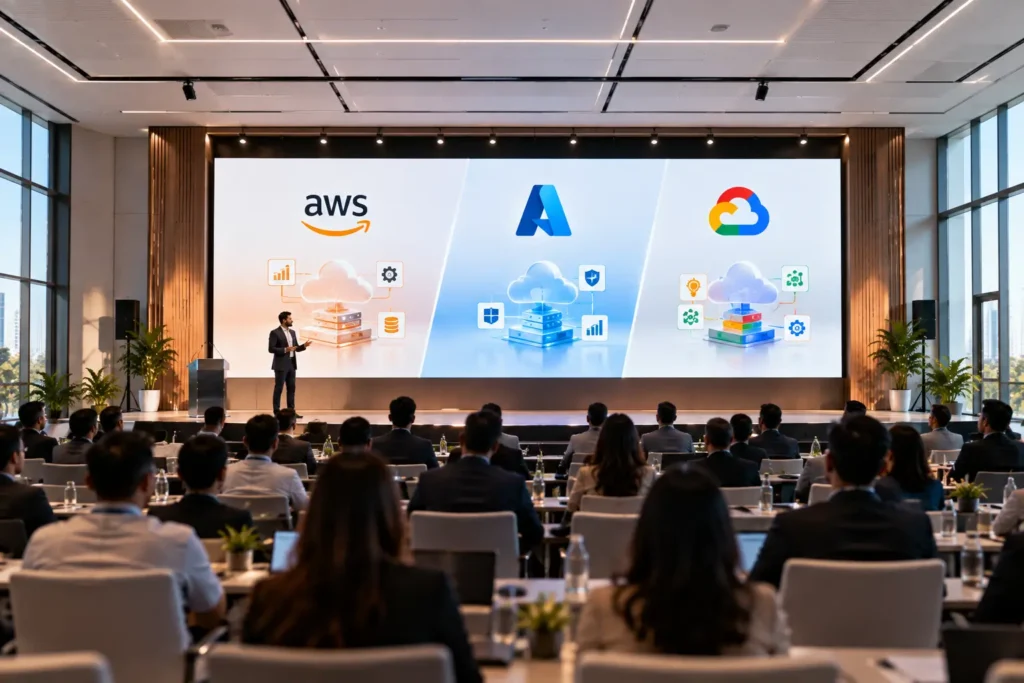
Most enterprises use more than one cloud, but you should still select a primary platform for each workload. The decision usually depends on your existing technology estate, the best-fit managed services, your team’s skills, and commercial terms. A Microsoft-heavy environment may favour Azure, a data and AI-focused workload may fit Google Cloud, and organisations seeking the broadest service portfolio may prefer AWS. As a certified AWS, Microsoft, and Google partner, Schnell Technocraft selects the platform according to each workload instead of defaulting to one vendor.Security, Compliance, and Governance
One of the strongest predictors of a smooth transformation is building security and governance into the foundation—the landing zone—before migrating any workloads. A secure landing zone provides:- Identity and access management (IAM) with least privilege by default.
- Network segmentation and private connectivity.
- Automated guardrails that prevent risky configurations.
- Centralised logging and monitoring connected to SIEM and SOAR capabilities.
- Data protection and compliance controls mapped to relevant regulations and standards, such as the DPDP Act and ISO 27001.
Cost Management and FinOps
Cloud can cost more than the data centre it replaces if no one owns spending. FinOps makes cloud cost a shared engineering and finance responsibility. The essentials include tagging every resource for visibility, right-sizing according to actual usage, using committed-use discounts for steady workloads, automating the shutdown of non-production resources, and reviewing costs with each team. Well-governed cloud environments can reclaim a meaningful share of spending without slowing delivery.Common Cloud Transformation Mistakes
- Lift-and-shift everything: A poorly designed application remains poorly designed in the cloud and may become more expensive.
- No landing zone: Migrating before identity, networking, and guardrails are established creates security debt.
- Ignoring costs until the bill arrives: Without FinOps, expected savings may never materialise.
- Big-bang cutovers: All-at-once migrations concentrate risk, while phased sprints contain it.
- Treating transformation as an IT-only project: Skills, processes, and change management matter as much as technology.
- Stopping at go-live: Value is realised through day-two operations and continuous optimisation.
How to Choose a Cloud Transformation Partner
- A phased, low-risk roadmap instead of a big-bang plan.
- Certified expertise across the platforms you will use, including AWS, Azure, and Google Cloud.
- Security-first architecture with landing zones, IAM, and guardrails designed from day one.
- A FinOps approach supported by real cost-governance examples.
- End-to-end accountability from strategy through day-two operations.
- Reference outcomes showing measurable improvements in cost, speed, uptime, and risk.
Cloud Transformation Checklist
- Business goals and success metrics are defined and agreed upon.
- An application and data inventory, including dependencies, is complete.
- Workloads are prioritised, and each has a selected migration strategy.
- A secure landing zone covering identity, networking, guardrails, and logging is designed.
- Security and compliance requirements are mapped to controls.
- A FinOps model covering tagging, budgets, and ownership is in place.
- The plan is divided into phased sprints with clear exit criteria.
- Day-two operations and knowledge transfer are planned.