
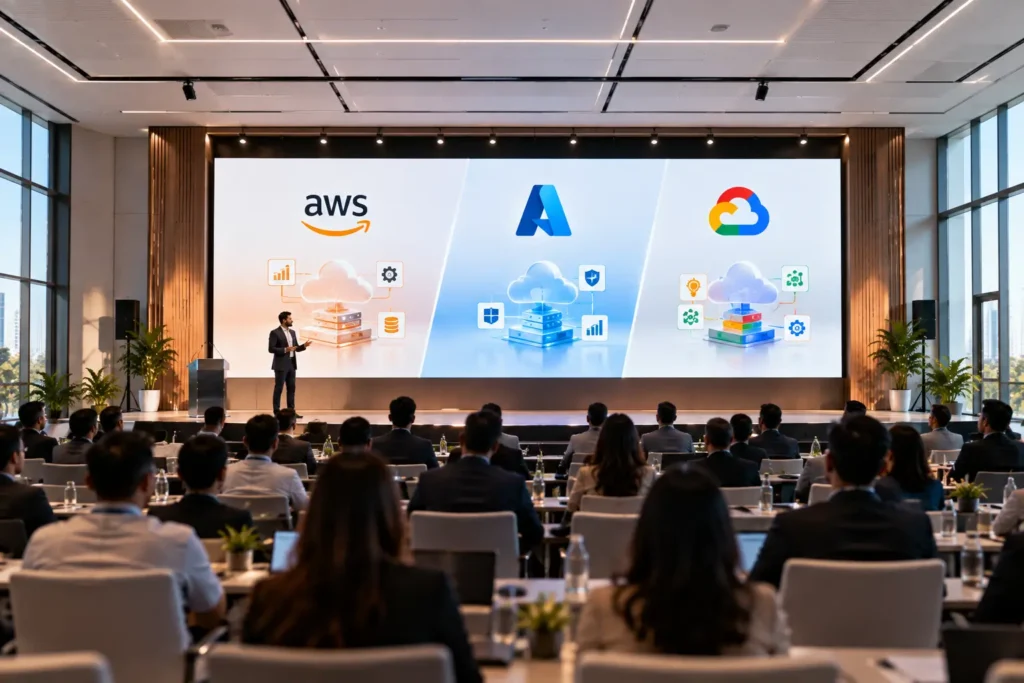
Quick Verdict
| If You Are… | Lean Toward | Why |
|---|---|---|
| A Microsoft-centric enterprise using Windows, Active Directory, Microsoft 365, or SQL Server | Microsoft Azure | Native integration, hybrid tooling, and enterprise-agreement leverage |
| Data-, analytics-, or AI-first | Google Cloud | BigQuery, strong data and AI tooling, and data-native architecture |
| Looking for the widest service breadth and largest ecosystem | AWS | The broadest service portfolio, a large partner network, and a deep talent pool |
| A regulated BFSI or public-sector organisation | Residency-led selection | Choose according to in-country regions, compliance requirements, and data localisation |
| Unsure or building a greenfield environment | AWS or the platform your team already knows | Familiarity generally creates the lowest execution risk |
Why “It Depends”
The three hyperscalers have converged. All offer capable compute, storage, databases, Kubernetes, serverless services, and AI tools. The choice is therefore rarely about one missing feature; it is about fit across five dimensions:- Existing estate and licences: What you already operate and pay for.
- Workload type: A data platform, customer application, and legacy ERP have different ideal environments.
- Data residency and compliance: Where data must reside and how it must be controlled.
- Skills and partner ecosystem: What your internal team and implementation partner can operate effectively.
- Commercial terms: Committed-use discounts, existing agreements, and INR billing.
India-Specific Factors That Influence the Decision
Data Residency and the DPDP Act
India’s Digital Personal Data Protection (DPDP) Act and sector-specific regulations influence where personal and regulated data can be stored and processed. For financial services, applicable RBI requirements may also affect data-location decisions. Confirm each workload’s residency requirements first, then evaluate whether each provider offers the necessary in-country regions and security controls, including encryption, key management, and access logging.In-Country Regions and Disaster Recovery
All three cloud providers operate regions in India, but their geographical coverage differs. This can affect your ability to design disaster recovery across two separate in-country regions.- AWS: Asia Pacific (Mumbai) and Asia Pacific (Hyderabad).
- Microsoft Azure: Central India (Pune), West India (Mumbai), and South India (Chennai), along with operator-partnered regions.
- Google Cloud: Mumbai and Delhi NCR.
Local Support, Partners, and Talent
Consider the depth of the local partner ecosystem and the availability of certified engineers for each platform in India. Both directly affect hiring, support quality, and delivery speed. AWS and Azure have very large footprints in India, while Google Cloud’s ecosystem continues to grow.Commercial Terms and INR Billing
Review INR billing, local invoicing, GST handling, and committed-use or reserved-capacity discounts for steady workloads. Existing enterprise agreements, particularly Microsoft agreements, can materially change the total cost.AWS, Azure, and Google Cloud: Key Strengths
Amazon Web Services (AWS)
Strengths: A broad and mature service catalogue, supported by a large partner and talent ecosystem. Best fit: Enterprises seeking maximum service breadth and a deep talent pool without being strongly tied to another vendor’s technology stack.Microsoft Azure
Strengths: Native integration with Windows, Microsoft Entra ID, SQL Server, and Microsoft 365, along with strong hybrid tooling and enterprise-agreement benefits. Best fit: Microsoft-centric enterprises and organisations operating hybrid environments.Google Cloud
Strengths: A data-native heritage, including BigQuery, strong data engineering and AI/ML capabilities, and a Kubernetes-first approach. Best fit: Data-, analytics-, and AI-first workloads. Organisations should also account for its smaller, although growing, Indian ecosystem.AWS vs. Azure vs. Google Cloud: Head-to-Head Comparison
| Dimension | AWS | Microsoft Azure | Google Cloud |
|---|---|---|---|
| Service breadth | Widest and highly mature | Very broad | Broad, with strong data and AI capabilities |
| India regions | Mumbai and Hyderabad | Pune, Mumbai, and Chennai, plus operator-partnered regions | Mumbai and Delhi NCR |
| Best known for | Service breadth and ecosystem | Microsoft integration and hybrid cloud | Data, analytics, and AI |
| Licensing advantage | No major cross-product advantage | Strong for organisations with existing Microsoft agreements | No major cross-product advantage |
| Data and analytics | Amazon Redshift and a broad supporting portfolio | Microsoft Fabric and Azure analytics services | BigQuery |
| AI and machine learning | Amazon Bedrock and SageMaker | Azure AI and Azure OpenAI Service | Vertex AI |
| Hybrid and on-premises | AWS Outposts | Azure Arc and Azure Stack | Google Distributed Cloud and GKE |
| Talent availability in India | Very large | Very large | Growing |
How to Choose: A Practical Decision Framework
Evaluate the following questions for each workload:- Residency: Must the data remain in India or comply with specific controls? Shortlist providers with suitable in-country regions.
- Estate fit: Does the workload depend on Microsoft technology, a particular database, or a specific analytics tool? Favour the platform that supports it most naturally.
- Skills: Which platform can your team and implementation partner operate confidently today? Familiarity lowers execution risk.
- Commercials: Do existing agreements or committed-use discounts change the financial case? Compare total cost rather than headline prices.
- Disaster recovery: Do you need two in-country regions? Confirm regional and service availability for your recovery architecture.
Choosing a Cloud Provider by Scenario
- Microsoft-heavy enterprise: Azure may be the strongest fit because of existing agreements and native integration.
- Data- or AI-first team: Google Cloud offers a data-native platform, while AWS or Azure may be preferable when proximity to the wider technology estate matters more.
- Regulated BFSI or public-sector organisation: Lead with residency, in-country disaster recovery, and compliance. Any of the three providers may work if it meets those requirements.
- Fast-scaling product company: Use the platform your engineers know best so they can deliver faster with less operational risk.
- Large, mixed technology estate: Expect a multi-cloud environment and standardise governance, identity, security, and FinOps from the beginning.