From task automation to intelligent automation
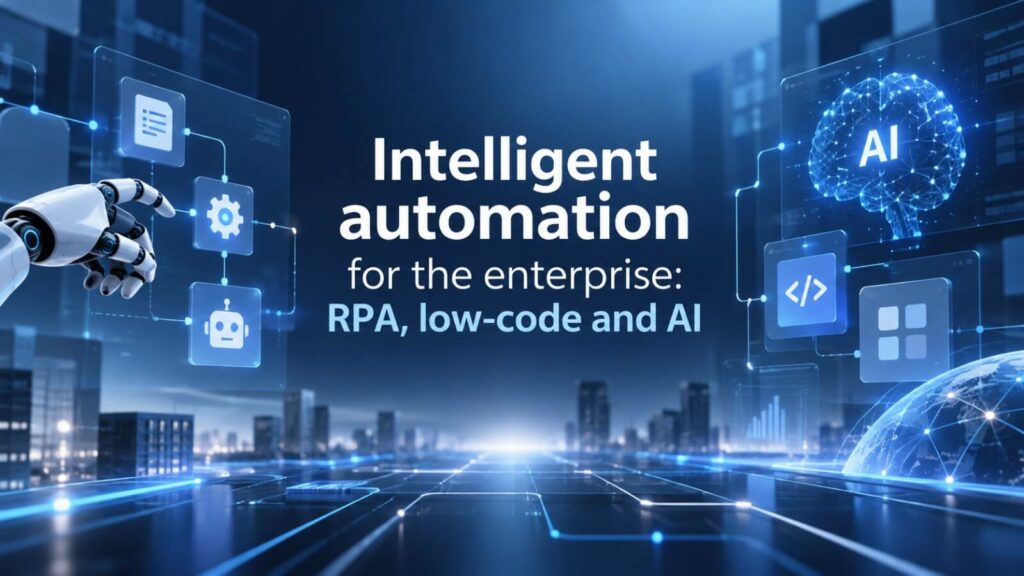
Most automation programmes stall for the same reason: they automate tasks, not outcomes. A bot moves data until the screen changes; a chatbot answers until the question gets hard; a low-code app solves one team’s problem and quietly becomes shadow IT. Intelligent automation is the shift from stitching together point solutions to building a single, governed capability — one that can handle the variation, unstructured inputs and exceptions that used to force a human back into the loop. A decade ago, automation meant a macro or a screen-scraping script. It worked until something moved. Intelligent automation is different in kind, not degree: it pairs the reliability of rules-based execution with the judgement of AI and the speed of low-code delivery. The result is automation that copes with ambiguity — reading a document, interpreting an email, deciding the next best action — rather than breaking at the first exception. The goal is no longer to automate a step; it’s to automate an outcome, end to end.The three building blocks
Robotic Process Automation (RPA)
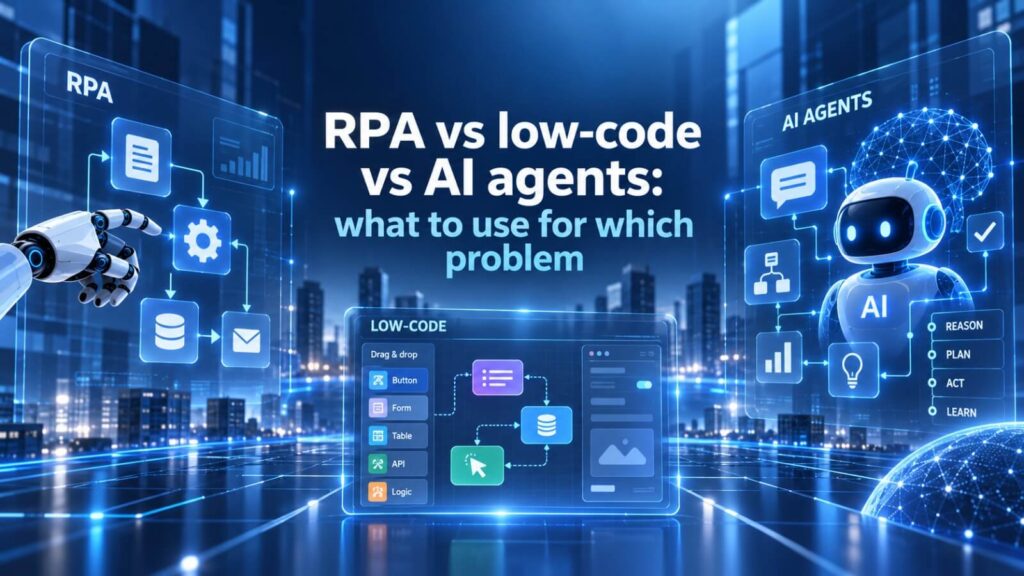
RPA is your digital workforce for structured, rules-based, high-volume work — moving data between systems, reconciling records, generating reports. It shines where processes are stable and inputs are predictable, and it’s the fastest way to remove repetitive effort without re-engineering underlying systems. Its limit is judgement: a pure rules engine breaks the moment it meets genuine ambiguity.Low-code / no-code
Low-code platforms let teams build apps, workflows and portals visually, in days instead of quarters. That matters for two reasons. It clears the backlog of “small but important” applications IT never gets to, and it puts safe, governed building tools in the hands of the people who understand the process best. Done well, citizen developers become a force multiplier; done badly, you inherit a sprawl of ungoverned apps.AI — including generative AI and agents
AI supplies the judgement RPA lacks: classifying an email, extracting fields from an invoice, summarising a case, or recommending an action. Generative AI extends this to language-heavy work — drafting, summarising, answering — and AI agents can now orchestrate multi-step tasks across systems. AI is what lets automation cope with the messy, unstructured majority of enterprise work.Better together: the hyperautomation stack
The value isn’t in any one technology — it’s in the composition. Take a familiar accounts-payable flow: AI reads and understands an incoming invoice (unstructured), RPA posts it to the ERP (structured and rules-based), a low-code app handles the approvals and exceptions that need a human, and analytics measures the whole thing. That layering — often called hyperautomation — is where straight-through-processing rates move from “some of the time” to “most of the time.” The discipline is knowing which tool owns which part of the job: rules for the deterministic steps, AI for the judgement, low-code for the human-in-the-loop, and process mining to find what to automate next.Where it pays off first
Start where volume, rules and pain intersect. The reliable early wins cluster in a few places: finance (invoice processing, reconciliations, month-end close), HR (onboarding and the joiner–mover–leaver lifecycle), IT and service operations (ticket triage, access and password requests, self-service), customer operations (case summarisation, response drafting, order status), and supply chain (data entry and exception handling). The pattern is consistent — high-frequency, cross-system work with a clear definition of “done.”A pragmatic adoption roadmap
The programmes that scale share an operating rhythm rather than a favourite tool:- Assess and discover. Use process mining and workshops to find the processes worth automating — not everything should be.
- Prioritise by value and feasibility. A simple effort-vs-impact matrix keeps you honest and gets a quick win on the board.
- Design for the whole process. Include exceptions, controls and the human steps, not just the happy path.
- Build with the right tool for each step. RPA, low-code and AI composed — not one technology forced to do everything.
- Scale with a platform and a Centre of Excellence. Reusable components, shared standards and a steady pipeline of ideas.
- Govern continuously. Monitor bots and agents, retrain models, and retire what no longer earns its place.
Governance, security and the human side
Automation multiplies whatever you point it at — including risk. Bots and AI agents need identities, least-privilege access and monitoring, just like people do. Ungoverned low-code becomes shadow IT. And AI needs guardrails for data handling, bias and hallucination. Equally important is the human side: the aim is to lift people off drudgery and onto higher-value work, and that only lands if you bring them with you — clear communication, training and a credible story about what changes. Automation done to people fails; automation done with them sticks.Measuring what matters
Track outcomes, not bot counts. The numbers that convince a CFO are hours returned, cycle-time reduction, straight-through-processing rate, error and rework rates, and cost-to-serve. Set a baseline before you start, instrument the process so the data is real, and review benefits realisation every quarter. A programme that can’t show its numbers won’t get funded twice.Key takeaways
- Automate outcomes, not tasks — the value is in composing RPA, low-code and AI, not choosing one.
- Rules for the deterministic steps; AI for the judgement; low-code for the human-in-the-loop.
- Start where volume, rules and pain intersect — finance, HR, IT/service ops, customer ops, supply chain.
- Govern from day one: identities and least-privilege for bots and agents, guardrails for AI, standards for low-code.
- Measure hours returned, cycle time and STP rate against a baseline — quarterly.