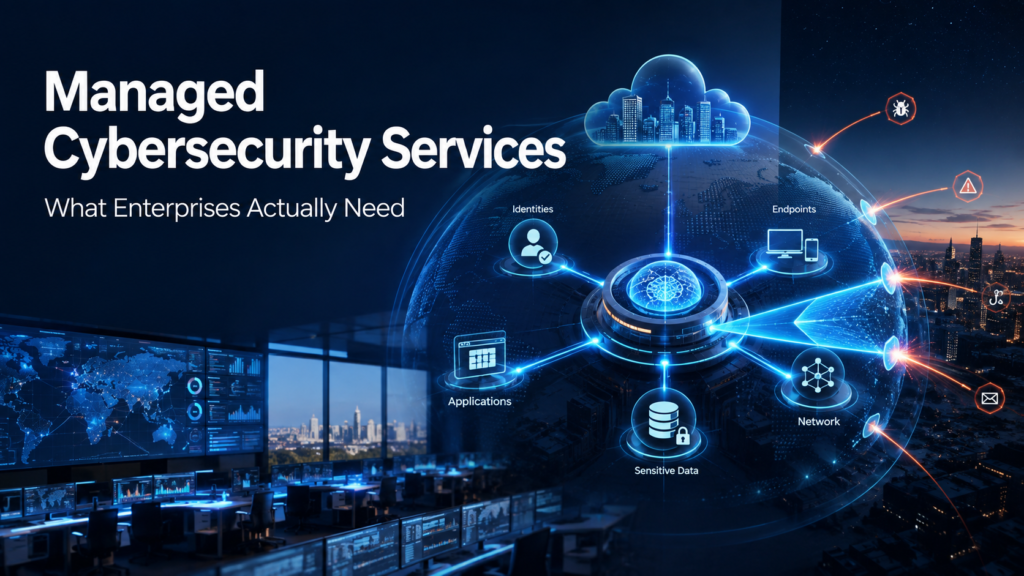
What Are Managed Cybersecurity Services?
Managed cybersecurity services are a subscription-based offering in which a specialist partner takes ongoing responsibility for detecting, preventing, and responding to security threats across your technology environment.
Instead of purchasing tools and hiring an entire security team, you receive a managed capability combining people, processes, and technology. It operates continuously and reports outcomes to your organisation.
The defining features are continuity and accountability. Monitoring operates 24×7×365, incidents are triaged and actively addressed instead of merely generating alerts, and one partner owns the outcome. That is the difference between a genuine managed service and a tool with a dashboard.
Why Enterprises Need Managed Security in 2026
- Threats are constant and automated: Attacks can arrive at any hour. Ransomware and supply-chain intrusions do not wait for business hours.
- Security talent is scarce and costly: A round-the-clock team is difficult to hire, expensive to retain, and challenging to keep current.
- The attack surface has expanded: Cloud platforms, remote work, SaaS applications, and identities multiply the areas that require protection.
- Regulation has raised the baseline: Data-protection and sector-specific rules increasingly require demonstrable controls, monitoring, and incident-response capabilities.
The practical reality is that many enterprises cannot economically operate a mature 24×7 security function alone. They therefore partner with specialists to obtain the required coverage and expertise.
What Managed Cybersecurity Actually Includes
A complete managed security capability covers five core areas. Be cautious of providers that offer only one component, such as monitoring, and describe it as comprehensive managed security.
| Capability | What It Does |
|---|---|
| Detection and response (MDR, SIEM and SOAR) | Provides 24×7 monitoring, threat detection, triage, and active incident response. |
| Identity and access management (IAM) | Controls who can access what through least privilege, multifactor authentication, and joiner-mover-leaver governance. |
| Endpoint security | Protects laptops, servers, and mobile devices using EDR and continuous patching. |
| Information protection | Classifies and safeguards sensitive information, prevents leakage, and enforces data governance. |
| Offensive testing (VAPT) | Uses vulnerability assessment and penetration testing to identify weaknesses before attackers exploit them. |
MSSP vs. MDR vs. SOC-as-a-Service
These terms overlap and are frequently used loosely. What matters is the depth of response and accountability you receive, not simply the label.
| Model | What It Emphasises | Best For |
|---|---|---|
| MSSP | Broad managed security covering areas such as device management, monitoring, and alerts. | Organisations seeking outsourced day-to-day security operations. |
| MDR | Detection and active response delivered by analysts who investigate and contain threats instead of merely sending alerts. | Enterprises that require fast, hands-on incident response. |
| SOC-as-a-Service | A complete outsourced security operations centre combining people, processes, and platforms. | Teams seeking SOC maturity without building an internal operation. |
Rule of thumb: If a provider only forwards alerts and expects your team to respond, it is not delivering genuine managed response. Ask exactly what the provider will do when an incident occurs at 3 a.m.
Build vs. Buy: In-House SOC or Managed Service?
Operating an internal 24×7 security operations centre is generally viable only at significant scale. Consider what building one actually requires:
- Round-the-clock staffing, often requiring 8–12 or more skilled analysts across shifts.
- Scarce and expensive specialisations, including threat hunting, incident response, and detection engineering.
- A SIEM, SOAR, and EDR technology stack that must be licensed, integrated, tuned, and maintained.
- Continuous threat-intelligence updates and full coverage during weekends and holidays.
For many enterprises, a managed partner delivers security maturity faster and more economically. A hybrid model is also common: the partner operates 24×7 security processes while the internal team retains business context and ownership of risk decisions.
The Managed Security Capabilities That Matter Most
Identity and Access Management
Identity is the new perimeter. Strong IAM enforces least-privilege access, multifactor authentication, and disciplined joiner-mover-leaver processes. These controls help prevent account takeover and limit the damage caused by compromised credentials.
Endpoint Detection and Response
In a hybrid workplace, every device can become an entry point. Managed EDR continuously monitors endpoints, investigates suspicious activity, isolates compromised devices, and helps keep systems patched.
SIEM, SOAR, and 24×7 Monitoring
A SIEM centralises security logs and identifies suspicious patterns, while SOAR automates repeatable response playbooks. Together, they transform a flood of signals into faster and more consistent action.
Information Protection and Governance
Managed information protection helps classify sensitive data, control how it moves, and prevent leakage. These capabilities are increasingly important under modern data-protection requirements.
Vulnerability Assessment and Penetration Testing
Offensive security testing identifies exploitable weaknesses before attackers do and validates whether your security controls work as intended.
Compliance and Regulation in India
For Indian enterprises, managed security should be designed around regulatory obligations from the beginning:
- Digital Personal Data Protection Act: Requirements relating to personal-data protection and breach handling.
- Sector-specific rules: Applicable requirements such as RBI guidance for financial services and SEBI requirements for capital markets.
- ISO 27001 and related frameworks: Structured information-security management expected by many customers and business partners.
Confirm current and organisation-specific requirements with your compliance team. The right managed security partner maps security controls and monitoring to these obligations and helps produce evidence for audits.
How to Choose a Managed Cybersecurity Partner
Evaluate providers using evidence and operational detail rather than marketing claims. Look for:
- Genuine 24×7 detection and response supported by defined response actions and service-level agreements.
- Coverage across the five core areas—IAM, endpoint security, information protection, SIEM/SOAR, and VAPT—or clear integration with your existing capabilities.
- Cloud expertise across AWS, Microsoft Azure, Google Cloud, and hybrid environments.
- Compliance mapping aligned with applicable regulations and reporting suitable for auditors.
- Transparent metrics covering mean time to detect, mean time to respond, monitoring coverage, and incident trends.
- End-to-end accountability from one partner that owns the outcome instead of passing responsibility across multiple vendors.
Enterprise Cybersecurity Readiness Checklist
- Do we have 24×7 detection and response, or only business-hours monitoring?
- Is identity governed using least privilege and multifactor authentication?
- Are all endpoints protected by EDR and continuously patched?
- Is sensitive data classified and protected against leakage?
- Do we conduct regular VAPT exercises and remediate the findings?
- Are our controls mapped to relevant regulations, and can we provide evidence?
- Do we know our mean time to detect and respond, and are those metrics improving?
Frequently Asked Questions
What are managed cybersecurity services?
Managed cybersecurity services provide the ongoing, outsourced protection of an organisation’s identities, endpoints, data, cloud platforms, and other systems. A specialist partner delivers 24×7 monitoring and response through a managed combination of people, processes, and technology.
What is the difference between MSSP, MDR, and SOC-as-a-Service?
An MSSP provides broad managed security and monitoring. MDR emphasises active threat detection and response by analysts who investigate and contain threats. SOC-as-a-Service supplies a complete outsourced security operations centre. Because the models overlap, select a provider based on its depth of response and accountability.
Should we build an in-house SOC or use a managed service?
Building a 24×7 SOC often requires 8–12 or more skilled analysts as well as a complete security technology stack. This may be practical only at significant scale. Many enterprises achieve maturity faster and more economically with a managed or hybrid model.
What does managed cybersecurity include?
A complete service typically includes detection and response through MDR, SIEM, and SOAR; identity and access management; endpoint security; information protection and governance; and vulnerability assessment and penetration testing.
How does managed security support DPDP and other compliance requirements?
A capable provider maps security controls and monitoring to applicable obligations, including the DPDP Act, RBI or SEBI requirements, and frameworks such as ISO 27001. It also supplies reporting that helps demonstrate compliance. Confirm specific legal requirements with your compliance advisers.
How do we measure whether managed security is working?
Track mean time to detect and respond, monitoring coverage, incidents contained, and vulnerability-remediation trends. Review these metrics regularly with your managed security partner.
Talk to Schnell About Managed Security
Schnell Technocraft delivers managed cybersecurity across identity and access management, endpoint security, information protection, SIEM and SOAR, and VAPT. As a certified AWS, Microsoft, and Google partner, we provide security that is built into your environment and supported by end-to-end accountability.
Start with a security assessment to understand your current position and identify the areas that should be prioritised.