Five years ago, “the workplace” was a floor of a building. Today it is wherever your people happen to open a laptop — a home office, a client site, a train, a branch, a partner’s meeting room. The shift to hybrid and remote work has been so complete that we’ve almost stopped calling it a trend. It is simply how organisations operate now.
But “working from anywhere” is deceptively hard to do well. It is easy to hand people a laptop and a video-conferencing licence and declare victory. It is far harder to build a workplace that is genuinely secure, genuinely productive, and genuinely adopted — all three at once, and for everyone. That is what a modern digital workplace means: not a collection of tools, but a coherent, secure environment where people do their best work from anywhere, and where IT can sleep at night.
This article sets out what that looks like in practice, and how to get there without the two most common failure modes: a beautiful rollout nobody uses, or a productive free-for-all with security holes you discover the hard way.
Key takeaways
- A modern digital workplace rests on four pillars — secure access, connected collaboration, managed devices, and real adoption — and weakness in any one undermines the others.
- Identity is the new perimeter. Zero-Trust access, MFA and device compliance are what make “work from anywhere” safe rather than reckless.
- Tools don’t transform anything on their own. The organisations that win treat adoption and change as first-class work, not an afterthought at go-live.
- The goal isn’t more technology — it’s a workplace people barely have to think about, because it just works, everywhere, securely.
What “modern digital workplace” actually means
Strip away the marketing and a digital workplace is the sum of everything an employee touches to get work done: how they sign in, the device in front of them, the apps they collaborate in, the files they open, and the security wrapped invisibly around all of it. “Modern” means that sum has three properties working together.
It is secure — access is verified continuously, data stays protected wherever it travels, and a lost laptop is an inconvenience, not a breach. It is productive — the tools are integrated rather than scattered, meetings and documents and conversations live in one place, and people spend their energy on work rather than on fighting the technology. And it is available anywhere — the experience is consistent whether someone is at a desk, at home, or on a phone between meetings.
The trap is treating these as separate projects owned by separate teams. Security bolts controls on after the fact; the collaboration team rolls out an app; someone else manages the laptops. The result is friction, gaps and frustration. A modern digital workplace is designed as one thing.
Secure by design
Zero-Trust identity, managed devices and protected data — so anywhere access never means anywhere risk.
Connected collaboration
One hub for chat, meetings, calling and content, so distributed teams work as one.
Any device, any place
Managed endpoints and virtual desktops that keep data central and work available everywhere.
Genuinely adopted
Change management and training so people actually work in the new way — where the value is realised.
Secure by design: identity is the new perimeter
When work happened inside an office network, security had a clear edge to defend. That edge is gone. People connect from home broadband and public Wi-Fi, on corporate and personal devices, to cloud apps that live nowhere in particular. Defending the old perimeter is defending a wall that no longer surrounds anything.
The modern answer is Zero Trust: never assume, always verify. Every request to access a resource is checked against who the user is, whether their device is healthy and compliant, and the context of the request — regardless of where it comes from. Identity, protected with multi-factor authentication and conditional access, becomes the real perimeter.
In a digital workplace, that translates into a few concrete things: strong, phishing-resistant sign-in for every user; access policies that adapt to risk (a managed, patched laptop gets a smoother path than an unknown device); data that is classified and protected so it stays safe even if it leaves; and endpoints that must prove they are healthy before they reach anything sensitive. Done right, this is largely invisible to employees — and it is precisely what lets you say “yes, work from anywhere” without wincing.
This is where the workplace and security disciplines meet. A well-built workplace on Microsoft 365 or Google Workspace should be hardened from day one, and the identity layer that underpins it — MFA, conditional access, least-privilege — is the foundation of Zero Trust security. They are not two projects. They are the same project seen from two angles.
“Work from anywhere” is only a benefit if “anywhere” is also secure. Identity, not the network, is what makes that true.
Connected collaboration, not tool sprawl
Ask most organisations what tools their teams use to communicate and you’ll get an uncomfortably long list: a chat app, a different meeting app, email, a file share, a couple of project tools, and a phone system that predates the cloud. Every tool is another silo, another login, another place to lose a decision.
The productive digital workplace consolidates this into a coherent hub — typically Microsoft Teams or Google Workspace — where chat, meetings, calling, and content collaboration live together and connect to the systems people actually work in. Modern telephony (calling built into Teams rather than a legacy PBX) folds the desk phone into the same experience. A well-structured intranet and document platform means people can find things instead of re-creating them.
The point isn’t to have more features. It’s to remove the friction of switching, searching and duplicating — to give distributed teams a single place where work happens and context is preserved. That is what turns “a group of people on video calls” into a team that genuinely collaborates. We go deeper on this in our communication and collaboration and remote and hybrid work services.
Any device, any place — with data kept central
Anywhere-work multiplies the number and variety of devices touching your data: company laptops, personal phones, tablets, contractor machines. Each is a potential entry point, and each needs to be productive without becoming a liability.
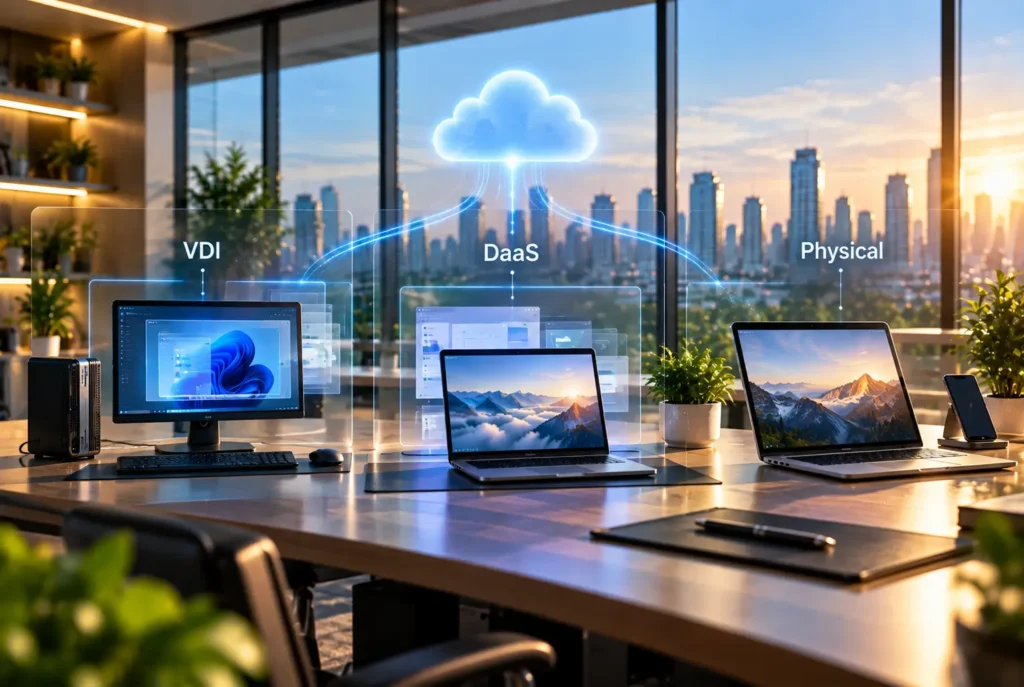
Two capabilities make this manageable. The first is unified endpoint management — provisioning, securing, patching and supporting every device from one place, so a new starter’s laptop arrives ready and compliant, and a personal phone can access work safely without the organisation taking over the whole device. The second, where it fits, is virtual desktops (Azure Virtual Desktop or Windows 365 Cloud PC): the desktop lives in the cloud, data never lands on the endpoint, and any device becomes a secure window into work.
Together, these mean the device matters less. Whether someone is on their own laptop or a shared machine, the experience is consistent, the data stays central and protected, and IT keeps control. Our device management & UEM and virtual desktop services are built around exactly this balance of freedom and control.
The part everyone underestimates: adoption
Here is the uncomfortable truth behind most disappointing digital-workplace programmes: the technology worked, and people didn’t use it. New tools were deployed, licences were paid for, and teams quietly carried on emailing attachments and meeting the old way. The investment delivered a fraction of its promise — not because it failed technically, but because nobody changed how they worked.
Adoption is not a training session at go-live. It is a deliberate stream of work: engaging leaders and impacted teams early, communicating the “why” clearly, delivering role-based training that meets people where they are, building a network of champions who spread new habits peer-to-peer, and measuring adoption so you can reinforce what isn’t sticking. Treated seriously — as we do in our change management and training practice — this is what separates a workplace that transforms an organisation from one that just refreshes its logos on the same old behaviours.
If you remember one thing from this article, make it this: the human side is where the value is won or lost. The most secure, elegant, well-integrated workplace in the world delivers nothing if people don’t live in it.
How to get there: a pragmatic path
You don’t build a modern digital workplace in one heroic project. You build it in deliberate phases, each delivering value and reducing risk. A sensible sequence looks like this:
- Assess and align. Understand how your people actually work, where the friction and risk are, and what “better” means for your organisation — before choosing a single tool.
- Secure the foundation. Get identity, MFA, conditional access and device compliance right first. Everything else stands on this.
- Consolidate collaboration. Bring communication, meetings, telephony and content into one governed hub, and retire the sprawl.
- Enable every device. Roll out managed endpoints and, where useful, virtual desktops — so anywhere-work is safe and consistent.
- Drive adoption relentlessly. Invest in change, training and champions from the start, and measure whether people are genuinely working the new way.
- Operate and improve. Run the environment reliably, watch the security signals, and keep refining — the workplace is a living thing, not a finished build.
For organisations that want the whole picture reimagined at once, this is the heart of a workplace transformation — strategy, technology and change delivered together, tied to real business outcomes.
The bottom line
A modern digital workplace is not a product you buy or a box you tick. It is a secure, coherent environment where your people do their best work from anywhere — protected by Zero-Trust identity, connected through a single collaboration hub, available on any managed device, and, crucially, genuinely adopted. Get those working together and technology stops being something people fight and starts being something they barely notice, because it simply works.
That is the real measure of success: not how impressive the tools are, but how invisible they become. Secure, productive, anywhere — for everyone, every day.